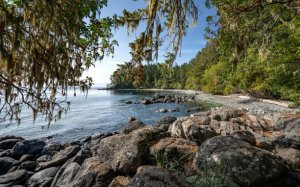
 There are places where you have to drive for hours to find wilderness.
And then there is Vancouver Island.
Vancouver Island wilderness has a way of appearing just beyond the edge of ordinary life. You can leave a café in downtown Nanaimo, drive for fifteen minutes, and find yourself beneath towering Douglas firs with nothing but the sound of wind moving through the canopy.
A few minutes further and the road can narrow, the houses disappear, and suddenly the landscape feels less like a suburb of a city and more like the edge of the world.
This is one of the things that makes Vancouver Island so compelling.
It isn’t wilderness in the remote, expeditionary sense.
You don’t necessarily have to pack a satellite phone, a week of provisions and a sense of impending doom. You can have a very good coffee first, and that’s precisely the point.
The Forest is Never Far Away
Vancouver Island’s forests have a way of making everything else feel temporary.
Some of the trees are hundreds of years old. 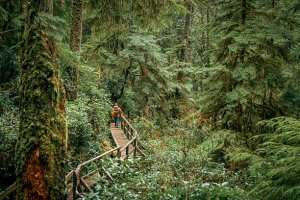 Their trunks are enormous, their branches disappearing into a canopy so high that the sky becomes something you glimpse rather than inhabit. Moss covers fallen logs. Ferns crowd the roadside. Rain hangs in the air and turns the forest floor brilliant green.
Even around populated areas, the forest doesn’t politely stop at the edge of town.
It presses in.
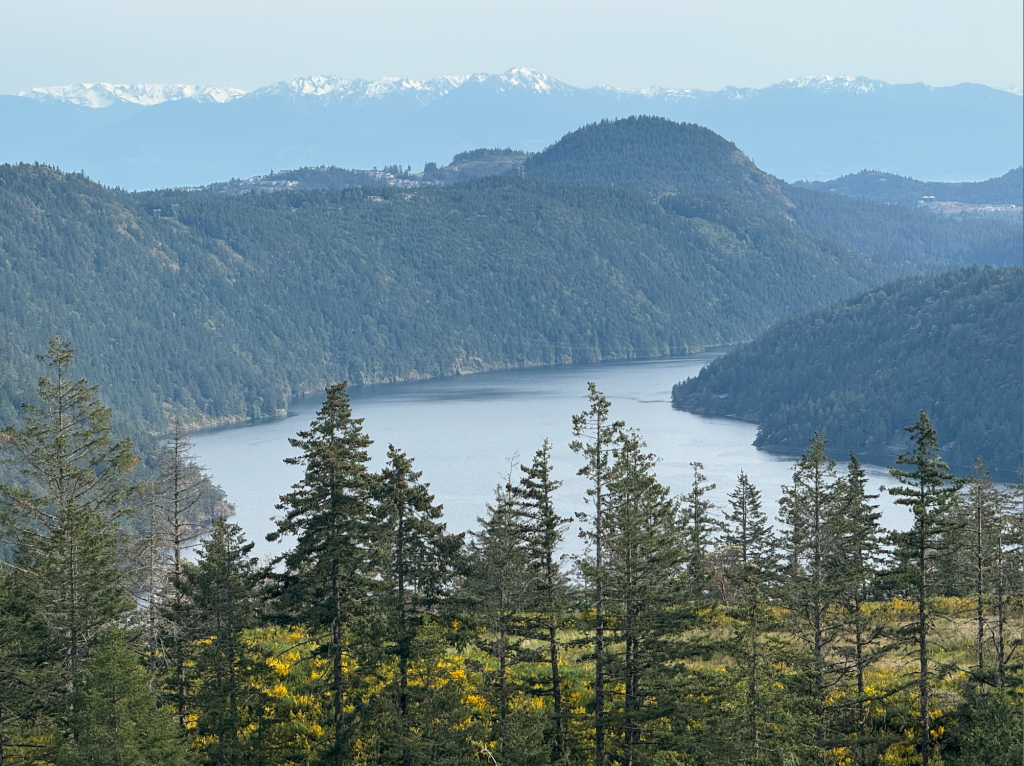
Drive outside Nanaimo and the landscape changes quickly. Roads wind through forest, mountains rise in the distance, and small pockets of development are surrounded by an overwhelming sense of nature. The same is true around communities such as Courtenay, Campbell River and Port Alberni.
And then there are the places where the forest meets the ocean.
That is when Vancouver Island really begins to feel wild.
Where the Mountains meet the Sea
The island is shaped by its relationship with water.
On the east coast, the Salish Sea creates sheltered bays, islands and inlets. On the west, the Pacific arrives with a completely different temperament.
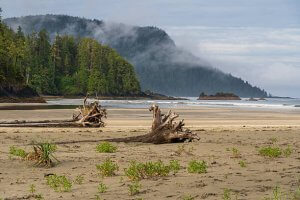 The west coast is raw.
Waves crash against beaches and rocky headlands. Storms roll in from the Pacific. Fog can swallow the landscape. The mountains drop toward the ocean, and enormous stands of old-growth forest stretch inland.
In places such as Tofino and Ucluelet, you don’t have to go far to experience that feeling of being wonderfully insignificant.
It is a landscape that still feels governed by nature rather than by us.
And that changes how you move through it.
Wildlife isn’t just Something You Go Looking for
On Vancouver Island, wildlife can feel less like an attraction and more like a neighbour who occasionally drops by.
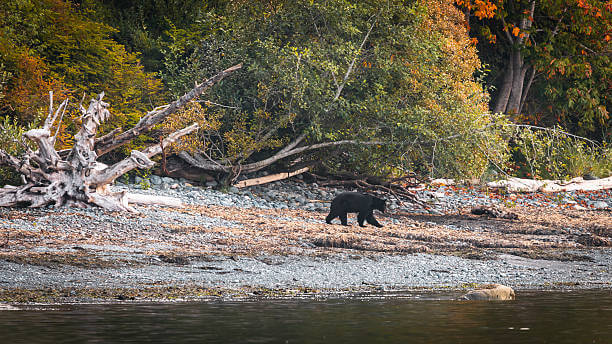
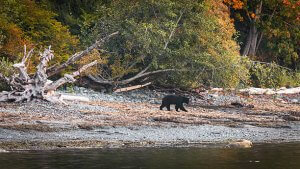 Black bears inhabit much of the island. Bald eagles are a familiar sight overhead. Seals appear around rocky shorelines. Sea otters can be spotted along the coast. Orcas and humpback whales move through surrounding waters.
You may set out specifically to see wildlife, but some of the most memorable encounters happen when you’re simply paying attention.
A dark shape moving through the water.
An eagle lifting from a tree.
The sudden appearance of a black bear beside the road, in your neighbourhood.
The splash of a seal disappearing beneath the surface.
It is a reminder that this is not a landscape designed entirely around human convenience. We are sharing it.
Even the weather feels untamed
Perhaps nothing makes Vancouver Island feel wilder than the weather.
The same place can feel completely different depending on the day.
A calm summer morning can bring glassy water and blue skies. By autumn, the Pacific begins to announce itself with heavy rain, wind and enormous waves. Winter storms transform the coastline into theatre.
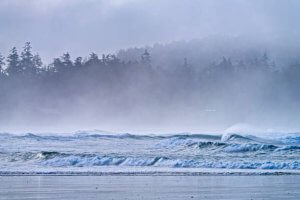
People come to watch. There is a reason we have storm season in Tofino.
Storm watching sounds almost absurdly passive until you experience it. Then you understand.
You stand on the edge of the Pacific and watch weather arrive with a force that makes the buildings, roads and everything else around you feel very small.
There is something deeply grounding about that.
Wilderness is Part of Everyday Life
Perhaps this is the real reason Vancouver Island feels wild.
It isn’t separated from everyday life.
It is woven through it.
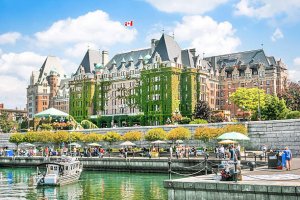 You can live close to restaurants, schools, shops and ferries and still wake to mountains outside your window. You can spend the morning answering emails and the afternoon hiking beneath ancient trees. You can kayak before dinner. You can walk a beach after work. You can drive twenty minutes and feel as though you’ve crossed into another world.
The boundaries between town and wilderness are unusually soft here.
And perhaps that is why people become so attached to the island.
It offers something increasingly rare: the possibility of living a modern life without completely disconnecting from the natural world.
You don’t have to choose between civilization and wilderness.
You can have both.
A good restaurant.
A comfortable bed.
Reliable Wi-Fi.
And somewhere nearby, an enormous forest quietly carrying on as it has for centuries.
That juxtaposition is part of the magic of Vancouver Island.
The wild isn’t somewhere you have to escape to.
It is already here.
Getting here is part of the experience
For somewhere that can feel this remote, Vancouver Island is surprisingly easy to reach.
From Vancouver, ferries cross to Nanaimo and Victoria, turning the journey itself into part of the adventure.
You can also fly directly to Vancouver Island, with Nanaimo, Victoria and Comox all offering air connections from major Canadian cities.
Once you’re here, having a car opens up the island in a completely different way.
The distances can look deceptively small on a map, but winding coastal roads, mountain passes and stretches of forest make the journey slower—and infinitely more interesting.
This isn’t a place where you necessarily want to rush from one destination to the next. Leave time for the unexpected: a roadside trailhead, a beach you’ve never heard of, a farm stand, a view that makes you pull over. On Vancouver Island, getting somewhere is often part of the discovery.