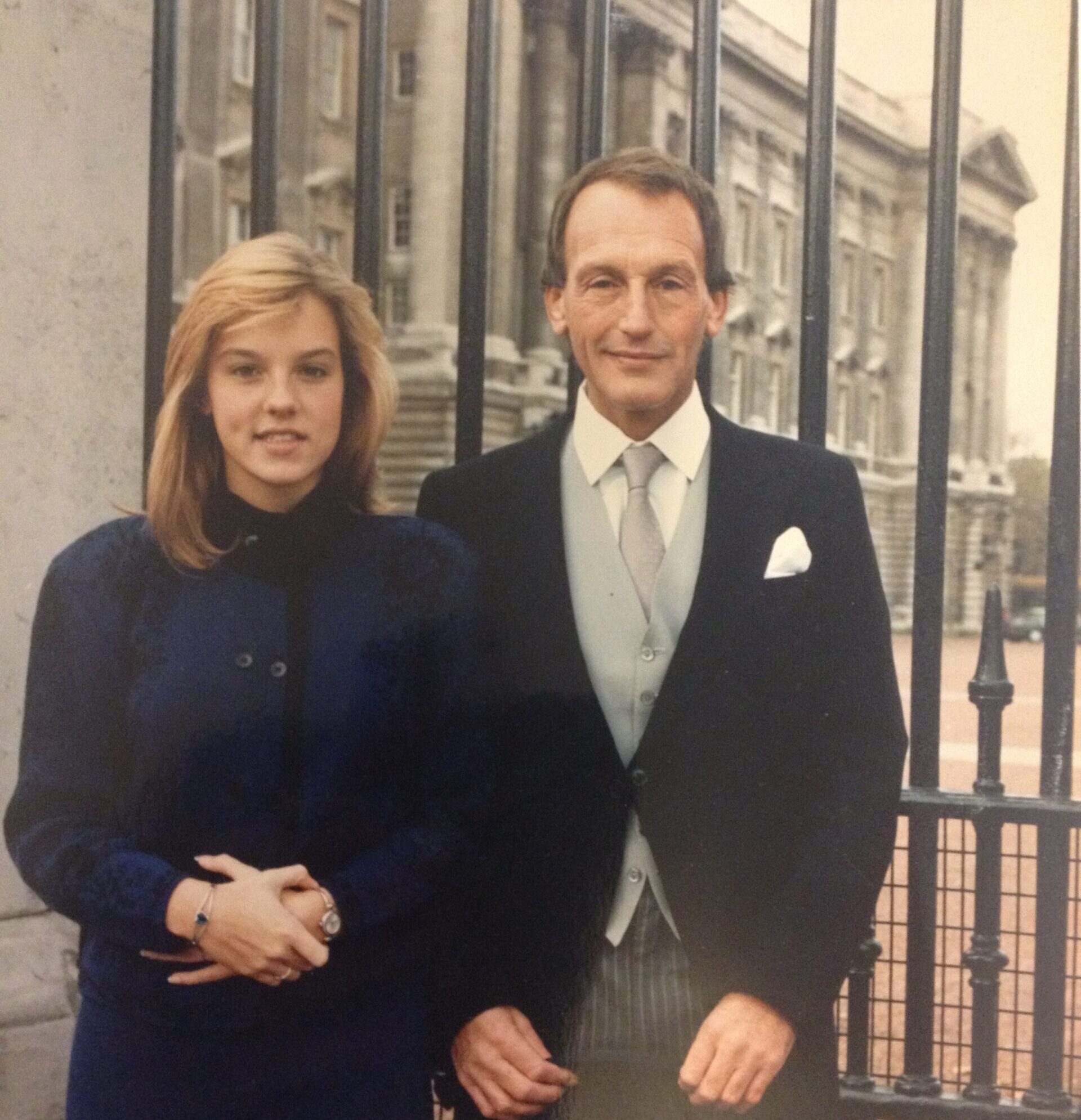
I was 17 and I had never imagined I would walk through the gates of Buckingham Palace. Not for tea, not for a tour, not even on a whim. Yet there I was, walking beside my father through the palace, about to watch him receive one of Britain’s highest honours. It was surreal.
My father, Roger Horrell, had spent much of his professional life in the shadows — working in diplomacy and intelligence, navigating a world where discretion was part of the job and recognition was rarely possible. Now, for one afternoon, he was being formally recognized. He was receiving the Companion of the Order of St Michael and St George — the CMG — and I was there with him.
The Father Behind the Secret
For much of my childhood, I didn’t really understand what my father did. I knew he travelled, I knew there were things he couldn’t talk about, and I knew that conversations sometimes stopped when other people entered the room. But the reality of his career only became clear to me gradually.
I remember one particular evening in Kenya, sitting around a campfire in the Maasai Mara. We were watching the wildlife and talking, and my father began trying to explain his work. Eventually, he gave up trying to explain it — or perhaps he simply couldn’t.
I looked at him and said, “Oh. You mean you’re like James Bond?”
That became one of those family stories that gets told again and again. But as I grew older, I began to understand that the reality was much more complicated and, in many ways, much more interesting. My father wasn’t James Bond. He was a diplomat, intelligence officer, relationship builder and, eventually, a senior leader within MI6.
His greatest skill wasn’t glamour. It was people. He knew how to listen, how to build trust, how to navigate complicated relationships and how to operate quietly when the situation demanded it. Much of his most important work would never be something he could tell us about.
Buckingham Palace
And then came the day when some of that invisible work became visible.
Walking into Buckingham Palace felt almost dreamlike. The marble floors, chandeliers and portraits created a sense of history that was difficult to ignore. Everything seemed designed to remind you that you were standing inside an institution much larger than any one person.
And yet, for me, the occasion wasn’t really about the palace. It was about my father.
I looked at him and thought about all the versions of him I had known: the father who took us to Africa, the quiet man who rarely spoke about his work, the man who could make an apparently ordinary family conversation feel slightly mysterious. He had spent decades doing work most people would never know about, and now he was standing in the middle of Buckingham Palace, being recognized for it.
A Life of Service
The CMG recognizes service connected with international affairs and diplomacy. For my father, it represented decades of work across Africa, the Middle East and Britain — first in the Colonial Service and later in the Secret Intelligence Service.
He had worked in Kenya, Dubai, Kampala and Lusaka, and had played a role in some of the most complicated political moments of his generation. He later returned to London and became Director of Personnel and Administration at MI6, helping to modernize the organization and develop a more accountable culture.
That part of his career has always interested me. For a man whose professional life had been so much about understanding people, his eventual responsibility for the people within the organization seemed strangely fitting. He was known for being discreet and reserved, but also fair and deeply loyal. Colleagues remembered his sympathy when people were dealing with personal or family difficulties.
He didn’t need to be the loudest person in the room. He understood that leadership could be quiet.
The Moment
As the ceremony began, I watched the formal choreography unfold: the introductions, the bows, the words and finally the medal. It was all very British and very precise.
Then the Queen herself presented my father with his CMG.
I remember watching her pin the insignia onto his uniform and thinking about the extraordinary distance between the man I knew as Dad and the person standing before the Queen in that moment. There was something deeply moving about seeing this private, quietly understated man being publicly recognized for a lifetime of service.
But I found myself watching my father rather than the ceremony. There was something moving about seeing a man whose professional life had depended upon invisibility suddenly being publicly acknowledged. For most of his career, success meant that nobody knew what he had done. Now, everyone in that room knew that he had done something worthy of recognition.
I felt enormously proud, but I also felt something else. I felt that strange intimacy that comes from suddenly seeing your parent as a person rather than simply as your father.
For a moment, I could see the life he had lived outside our family: the places he had been, the people he had known, the decisions he had carried and the things he had never been able to tell us.
The Photograph
There is a photograph of me accompanying my father to Buckingham Palace that I treasure. When I look at it now, I don’t just see a daughter standing beside her father. I see two worlds meeting: his world of diplomacy, intelligence and public service, and mine, which was still unfolding.
At the time, I couldn’t have known how much his example would influence me. I didn’t follow his career and I didn’t inherit his profession, but perhaps I inherited something else — a curiosity about people, a fascination with place, a willingness to cross borders, both geographical and cultural, and an instinct to look beyond the obvious story.
What We Carry Forward
My father died in 2021. After his death, I read the obituaries and accounts of his career and discovered pieces of his life that I had never known. It was a strange experience. I knew the man, but I was still discovering his story.
Perhaps that is true of all our parents. We know them first as Mum or Dad. Only later do we begin to understand the individual who existed before us — the ambitions, mistakes, adventures, friendships and choices that shaped the person who eventually became our parent.
That day at Buckingham Palace gave me a glimpse of that larger life.
The medal was beautiful and the palace was extraordinary, but what I remember most is walking beside him. The feeling of his hand in mine. The pride. The quiet joy.
And the realization that sometimes the greatest privilege isn’t being recognized yourself. It is being there to witness someone you love finally receive the recognition they deserve.
I still think about that day. Somewhere between the campfires of Africa and the corridors of Buckingham Palace, I began to understand my father not simply as the mysterious man who once told me he was a spy, but as a human being who had spent his life trying, in his own quiet way, to make a difference.
I am grateful that I got to walk beside him for a little while.